

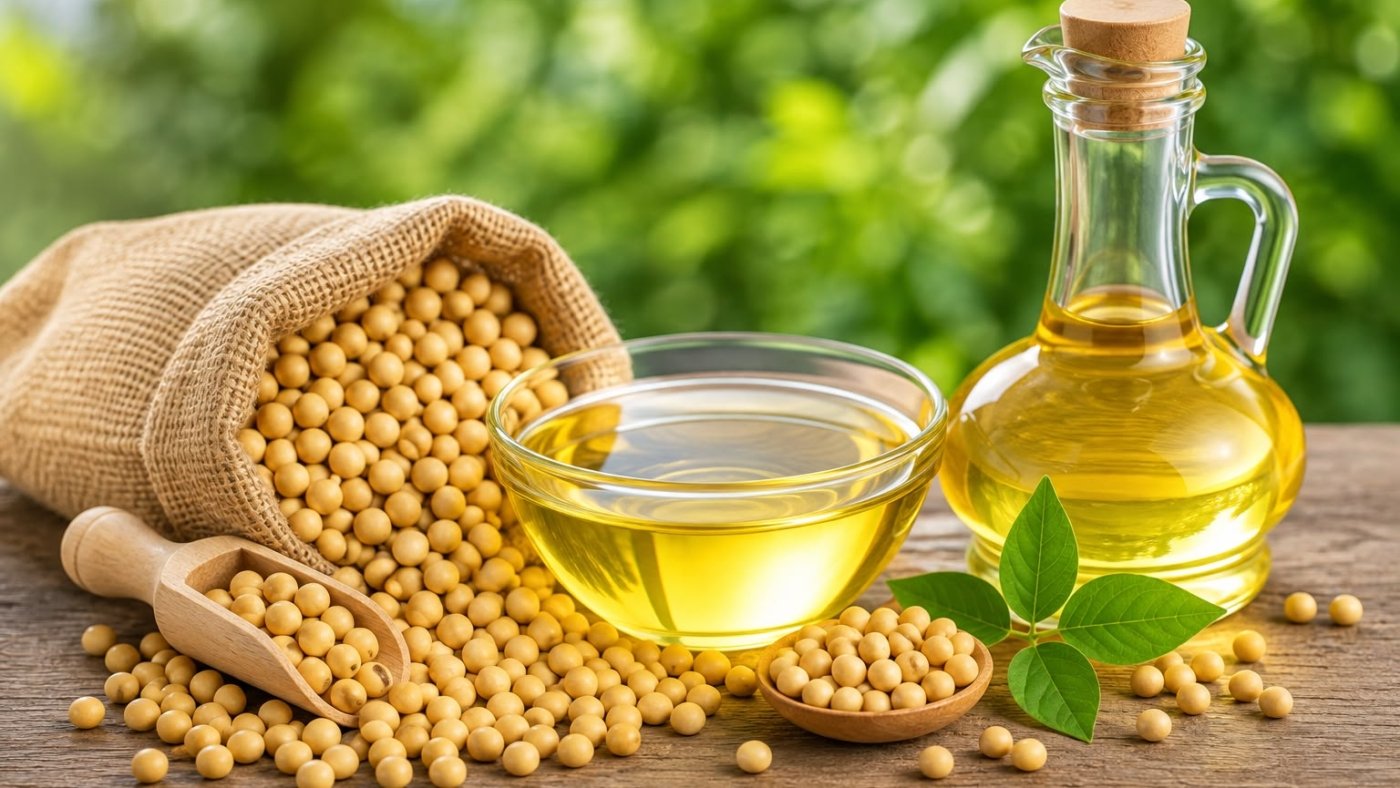
Soybean Oil: From Bean to Bottle – Production, Global Consumption, Health Benefits and the Technology Behind It
Until recently, I had associated soybean mainly with soy foods, tofu and soybean meal. I was surprised to discover how important soybean oil has become in the global vegetable-oil industry, particularly across Asia and the Americas.
This article explores the journey from bean to bottle.
What is soybean oil?
Soybean oil is extracted from the seeds of the soybean plant, Glycine max.
Soybeans are commercially interesting because almost every major fraction of the seed has economic value. The beans contain approximately 18–20% oil, although the exact composition varies according to variety and growing conditions.
The two major commercial products are:
- Soybean oil – used for food, food processing, biodiesel and several industrial applications.
- Defatted soybean meal – a valuable high-protein co-product used predominantly in animal feed.
This makes soybean processing a good example of maximum utilisation of an agricultural raw material.
The objective is not simply to extract oil. It is to recover valuable products efficiently while maintaining quality, safety, energy efficiency and economic viability.
How is soybean oil produced?
At a simplified level, the soybean oil production process can be represented as:
Soybeans → Cleaning → Conditioning → Dehulling → Cracking → Flaking → Cooking/Conditioning → Solvent Extraction → Crude Soybean Oil → Degumming → Refining → Bleaching → Deodorisation → RBD Soybean Oil
The actual configuration varies according to plant capacity, raw material characteristics, extraction technology and the desired end product.
Let us look at the major stages.
1. Cleaning and preparation of soybeans
The soybean first has to be prepared for efficient oil extraction. The incoming beans may contain – stones, dust, plant material, metal particles, foreign seeds, other impurities.
Cleaning equipment removes these contaminants. The beans are then conditioned and prepared for further processing.
2. Dehulling, cracking and flaking
Depending on the process design, the soybeans may be dehulled before being cracked. The beans are mechanically cracked into smaller pieces and then passed through flaking rolls.
Why is flaking important? – The objective is to rupture the cellular structure of the soybean and create a large surface area, making the oil more accessible during extraction.
Good preparation therefore has a direct impact on oil recovery and downstream process efficiency.
3. Solvent extraction – recovering the oil
For large-scale commercial soybean processing, solvent extraction is widely used because of its high oil-recovery efficiency. The prepared soybean flakes are contacted with a solvent, traditionally hexane, which dissolves the oil present in the flakes.
The resulting oil-solvent mixture is called miscella. The solvent is subsequently separated from the oil and recovered for reuse. The extracted solid material becomes defatted soybean meal, which is an important commercial product in its own right.
This is one of the fascinating aspects of soybean processing:
The business is not simply an oil business. It is an integrated raw-material utilisation business.
The economics of the plant depend on the value and recovery of both oil and meal.
4. Crude soybean oil
The oil obtained immediately after extraction is known as crude soybean oil.
It is not the same as the refined soybean oil sold in a supermarket.
Crude oil can contain: phospholipids or gums, free fatty acids, pigments, moisture, trace metals, oxidation products & other minor components.
These substances need to be reduced or removed before the oil can meet the required specifications for its intended application. This is where refining technology becomes critical.
Refining soybean oil
A simplified refining sequence can include:
Degumming → Neutralisation → Bleaching → Deodorisation
The exact refining route depends on the crude oil characteristics and the plant design.
Degumming
Phospholipids, commonly referred to as gums, are removed during degumming.
Water and/or acid treatment can hydrate or condition the phospholipids so that they can be separated from the oil. Efficient degumming is important not only for oil quality but also for the performance of subsequent refining stages.
Neutralisation
In conventional chemical refining, free fatty acids are neutralised using an alkali such as sodium hydroxide, to reduce the free-fatty-acid content and remove associated impurities.
Alternative refining configurations, including physical refining, may also be used depending on the characteristics of the crude oil and the desired process economics.
Bleaching
The word “bleaching” can be misleading. It does not mean bleaching the oil in the ordinary sense.
Adsorbent materials such as bleaching earth are used to remove pigments and other undesirable substances from the oil. This helps improve the colour and quality of the refined product.
Deodorisation
The final major refining stage is deodorisation.
Here, volatile compounds responsible for undesirable odours and flavours are removed, typically using steam under high vacuum and elevated temperature.
The result is a refined oil with the desired colour, odour and flavour characteristics.
The finished product is commonly referred to as: RBD Soybean Oil – Refined, Bleached and Deodorised Soybean Oil
So, the oil sitting in a bottle on a supermarket shelf has travelled through a carefully controlled sequence of mechanical preparation, extraction, separation and refining operations.
How is soybean oil consumed around the world?
Soybean oil is remarkably versatile. It can be consumed directly as cooking oil or incorporated into a wide range of food products.
Household consumption – Soybean oil is used for: cooking, frying, sautéing, baking, salad preparation, general food preparation. Its relatively neutral flavour makes it suitable for a wide range of culinary applications.
Food manufacturing – Soybean oil is also used in: mayonnaise, salad dressings, sauces, margarine and spreads, bakery products, snacks, processed foods.
Thus, a consumer may consume soybean oil without necessarily recognising it as soybean oil. It can enter the diet as an ingredient in a processed food product.
Food-service industry
Restaurants, commercial kitchens and institutional food-service operations are also important users of edible oils.
The choice of oil depends on several factors, like: price, availability, flavour, stability, cooking performance, nutritional considerations and application.
Soybean oil beyond food
Soybean oil is not only an edible oil. It is also a feedstock for a number of non-food applications.
These include: biodiesel, certain coatings, printing inks, lubricants, soaps, oleochemical products, other bio-based industrial applications
The growing connection between vegetable oils and biofuels has created an additional source of demand.
This gives soybean oil a unique position at the intersection of food, agriculture, energy and industrial processing.
Where is soybean oil produced?
One of the most interesting aspects of the soybean industry is the difference between soybean production and soybean-oil production. The countries that grow the largest quantities of soybeans are not necessarily the countries that produce the most soybean oil.
Why?
Because soybean oil production depends heavily on the location and capacity of soybean crushing and processing facilities.
USDA data indicate that China, the United States, Brazil and Argentina are among the world’s leading soybean-oil producers.
Indicative recent production figures include:
| Country/Region | Approximate soybean-oil production |
| China | ~19.8 million tonnes |
| United States | ~13.1 million tonnes |
| Brazil | ~11.6 million tonnes |
| Argentina | ~8.5 million tonnes |
| European Union | ~2.85 million tonnes |
| India | ~2.0 million tonnes |
| Mexico | ~1.3 million tonnes |
| World | ~68.6 million tonnes |
Figures vary by marketing year and data revision; the table represents recent USDA estimates (2024-2025) rather than a fixed annual production figure.
This leads to an important observation:
The country that grows the most soybeans is not necessarily the country that produces the most soybean oil.
China, for example, has enormous soybean-crushing capacity and very large domestic demand.
Who consumes the most soybean oil?
Soybean oil consumption is concentrated in several large markets.
Recent USDA estimates indicate approximately:
| Country/Region | Approximate soybean-oil consumption |
| China | ~20.8 million tonnes |
| United States | ~13.4 million tonnes |
| Brazil | ~10.5 million tonnes |
| India | ~6.55 million tonnes |
| European Union | ~2.7 million tonnes |
| Argentina | ~2.0 million tonnes |
| Mexico | ~1.38 million tonnes |
| Bangladesh | ~1.19 million tonnes |
| Egypt | ~0.84 million tonnes |
| World | ~70 million tonnes |
Again, these figures should be read as marketing-year estimates, because agricultural commodity statistics change with production, stocks, trade and revised forecasts.
China, the United States, Brazil and India are particularly important consumption markets.
From Seed to Oil: Where Process Technology Makes the Difference
For us at Plant Technologies International, the most interesting part of the soybean story is not only the oil that reaches the consumer. It is the plant and process technology that makes the transformation possible.
The journey can be summarised as:
Agriculture → Storage → Cleaning → Preparation → Extraction → Separation → Refining → Quality Control → Packaging → Distribution
Every stage involves engineering decisions. A modern soybean oil plant must carefully manage parameters such as: temperature, pressure, flow, moisture, vacuum, residence time, solvent recovery, chemical dosing, filtration, separation, refining conditions, product quality.
The difference between an average plant and a well-designed, efficiently operated plant can ultimately be reflected in:
oil recovery + product quality + energy consumption + operating cost + safety + environmental performance + profitability.
This is where process engineering, plant design, instrumentation, automation and operational control come together.
Why plant design matters
Oil extraction and refining are not isolated operations. A decision made in the preparation section can affect extraction efficiency. Extraction performance can affect crude-oil quality. Crude-oil quality can influence refining requirements.
Refining conditions affect oil losses, energy consumption and final product quality.
Therefore, a soybean oil plant needs to be viewed as an integrated process system, rather than as a collection of individual machines. Good plant engineering should seek to optimise the complete system.
The bigger picture
The soybean oil story is ultimately a story about value addition.
A farmer grows a soybean. A processor converts it into oil and protein-rich meal. A refinery converts crude oil into a high-quality edible product. A food manufacturer may convert that oil into another consumer product. A restaurant may use it for cooking. A consumer may purchase it without ever seeing the soybean from which it originated.
Behind this apparently simple journey lies an extensive network of:
agriculture, logistics, storage, mechanical processing, extraction, chemical processing, instrumentation, automation, quality control, energy management and supply-chain management.
That is what makes vegetable-oil processing such an interesting area of process engineering.
Conclusion
Soybean oil is much more than another cooking oil. It is one of the world’s major vegetable oils, connecting agriculture, food, nutrition, energy and industrial processing.
Its journey from soybean to refined oil involves multiple carefully controlled stages, from seed preparation and extraction to degumming, refining, bleaching and deodorisation.
Its global importance is demonstrated by the scale of production and consumption across China, the United States, Brazil, India and other markets.
At the same time, the health discussion requires balance. Soybean oil can be part of a healthy dietary pattern, particularly when used instead of fats higher in saturated and trans fats. But no edible oil should be viewed in isolation from the overall diet.
For the process industry, the more fundamental lesson is perhaps this:
The value of an agricultural commodity is created not only in the field, but also through the technology that transforms it into a useful product.
From bean to bottle, soybean oil is a powerful example of how process engineering creates value.
Interested in setting up or upgrading a Soybean Oil Processing Plant?
Plant Technologies International provides technology, equipment, spares and accessories for soybean oil processing plants.
Whether you are evaluating a new project, expanding an existing facility or looking for process equipment and technical support, the right plant configuration can make a significant difference to recovery, product quality, operating efficiency and long-term economics.
Let us discuss your requirement.
Contact Plant Technologies International to explore soybean oil plant solutions tailored to your processing capacity, raw material and product requirements.
From soybean to refined oil – let technology create the value.
Website: www.planttechint.com
#SoybeanOil #SoybeanOilProduction #EdibleOil #VegetableOil #OilExtraction #OilRefining #ProcessEngineering #FoodProcessing #PlantEngineering #SoybeanProcessing #SolventExtraction #RBDOil #FoodTechnology #PlantTechnologiesInternational
Add a Comment