

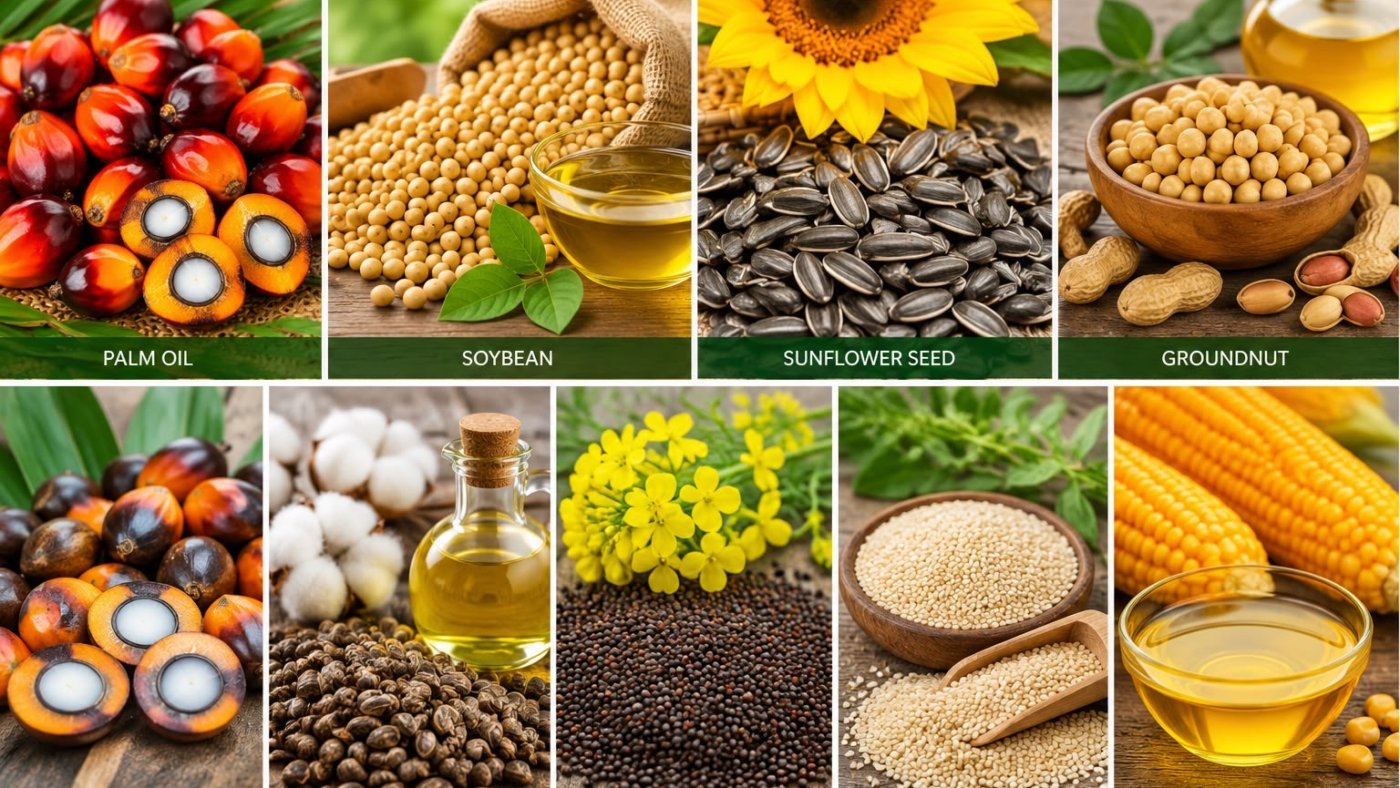
Understanding coconut, sesame, rice bran, sunflower, palm and soybean oils in the Indian context
Walk into any Indian supermarket and the choice of cooking oils can be confusing.
Coconut oil. Gingelly oil. Rice bran oil. Sunflower oil. Palm oil. Soybean oil. Groundnut oil.
Every oil seems to have its own health claim. One is rich in MUFA. Another is rich in PUFA. One is traditional. Another is inexpensive. Some are promoted as heart-friendly. So, which edible oil is actually healthy? And can we find an oil that is both healthy and economical?
The answer is not as simple as choosing one “best” oil. To understand why, we first need to understand the different types of fats.
Saturated, MUFA and PUFA – what do they mean?
Saturated fats
Saturated fats contain no double bonds in their fatty-acid structure. Oils relatively high in saturated fat include coconut oil and palm oil. Excessive consumption of saturated fat is generally discouraged, particularly when it replaces unsaturated fats in the diet.
MUFA – Monounsaturated Fatty Acids
MUFA contains one double bond. Oleic acid is the principal example. Oils such as sesame, rice bran, groundnut and olive oil contain significant amounts of MUFA.
PUFA – Polyunsaturated Fatty Acids
PUFA contains two or more double bonds. The important families are omega-6 and omega-3 fatty acids.
Sunflower and soybean oils are particularly rich in PUFA, while sesame oil also provides significant PUFA.
The important nutritional principle is not simply “MUFA good, PUFA good, saturated bad”. What matters is the overall dietary pattern and what type of fat is being replaced.
How do the common Indian cooking oils compare?
| Oil | Broad fatty-acid profile | Key characteristic | Typical use |
|---|---|---|---|
| Coconut | High saturated fat | Traditional, distinctive flavour | Kerala & South Indian cooking |
| Sesame/Gingelly | MUFA + PUFA | Traditional oil with natural lignans | Indian cooking |
| Rice Bran | MUFA + PUFA | Balanced profile, contains oryzanol | Everyday cooking |
| Sunflower | High PUFA | Light flavour, widely available | Everyday cooking |
| Soybean | High PUFA | Contains omega-3 ALA | Cooking & food processing |
| Palm/Palmolein | Higher saturated fat | Economical and functional | Frying & food processing |
The exact composition varies with the oil variety, processing method and product specification.
Coconut Oil – tradition versus nutrition
Coconut oil has an important place in Kerala’s food culture. It gives food a distinctive flavour and remains widely used in traditional cooking. However, coconut oil is very high in saturated fatty acids compared with most liquid non-tropical vegetable oils.
Therefore, while coconut oil can certainly be part of a traditional diet, it should not automatically be considered the healthiest oil simply because it is natural or traditional.
Best suited for: Traditional cooking where its flavour is desired.
Sesame Oil – Gingelly Oil (Sesame oil) has been used in India for generations.
It provides both MUFA and PUFA and contains naturally occurring compounds such as sesame lignans and tocopherols. It has a distinctive flavour and is particularly suited to several South Indian preparations.
Best suited for: Traditional Indian cooking and dishes where its characteristic flavour is valued.
Rice Bran Oil – an interesting Indian option
Rice bran oil has become increasingly popular in India. It contains both MUFA and PUFA and also contains naturally occurring compounds such as gamma-oryzanol, tocopherols and tocotrienols. Its relatively neutral flavour makes it versatile for everyday cooking. There is also an interesting sustainability angle: rice bran is generated during rice milling, and extracting oil from it creates additional value from an agricultural by-product.
Best suited for: Everyday cooking where a neutral-flavoured oil with a balanced unsaturated-fat profile is preferred.
Sunflower Oil
Sunflower oil is one of the most widely used cooking oils in Indian households. Conventional sunflower oil is generally rich in linoleic acid, an omega-6 PUFA, and relatively low in saturated fat. It has a light flavour and is suitable for a variety of cooking applications.
However, not all sunflower oils have exactly the same fatty-acid profile. High-oleic sunflower oil, for example, is different from conventional high-linoleic sunflower oil. Best suited for General household cooking and food preparation.
Palm Oil and Palmolein – why are they so economical?
Palm oil is often criticised because of its relatively high saturated-fat content. But there is another side to the story.
Palm oil is extremely productive as an oil crop and has a well-developed global processing and supply chain. This helps make palm oil and palmolein economically competitive. They also have useful functional properties, particularly in frying and processed foods. So Palm oil may score highly on economics and industrial functionality, even though it is less attractive when the objective is to minimise saturated-fat intake.
Best suited for: Food processing, frying and applications where cost and functionality are important.
Soybean Oil
Soybean oil is one of the world’s major vegetable oils. It is relatively low in saturated fat and rich in PUFA. It also contains alpha-linolenic acid (ALA), an omega-3 fatty acid. It is widely used in household cooking and food manufacturing.
Best suited for: Everyday cooking and food-processing applications.
Which oil is the healthiest?
There is no universal winner. If we want to minimise saturated fat, oils such as sunflower, soybean and some other unsaturated vegetable oils may be preferable to coconut or palm oil. If we want a traditional South Indian flavour, coconut or sesame oil may be more appropriate.
If we want a relatively neutral everyday oil, rice bran or sunflower oil may be attractive. Where the priority is industrial frying and cost, palmolein has significant advantages.
The better question is: Which oil is appropriate for this application and dietary pattern?
Is there an oil that is both healthy and inexpensive?
This is perhaps the most interesting question. There is no single oil that wins on every parameter. Price depends on: raw-material availability, crop yield, extraction efficiency, refining cost, energy consumption, transportation, import dependence, international commodity prices, taxes and distribution.
Health depends on: fatty-acid composition, quantity consumed, what the oil replaces, the overall diet. As such the “cheapest” does not automatically mean “healthiest”, and “most expensive” does not automatically mean “healthiest”. For many Indian households, a sensible approach may be to use different oils for different culinary purposes or alternate oils, rather than searching for one perfect oil.
The Plant Technologies perspective
There is another side to the edible-oil story that consumers rarely see. Behind every bottle of cooking oil is a processing plant. Whatever be the raw material, the fundamental challenge remains the same:
How do we extract maximum value from the raw material efficiently, safely and economically?
This requires:
- raw-material preparation
- oil extraction
- filtration and separation
- refining
- bleaching
- deodorisation
- heat transfer
- vacuum systems
- instrumentation
- process control
- automation
- quality control
- energy management
The efficiency of these processes ultimately affects oil recovery, product quality, operating cost and plant profitability.
From Seed to Oil – Technology Creates Value
The edible-oil industry is therefore much more than the oil we see on a supermarket shelf. It is a combination of:
Agriculture + Process Engineering + Extraction Technology + Refining + Instrumentation + Quality Control + Economics
At Plant Technologies International, we look at edible-oil processing from this complete plant perspective. Whether the requirement is for soybean oil, rice bran oil, sesame oil, sunflower oil or other vegetable-oil processing, the right plant technology can help improve recovery, efficiency, quality and economics.
From Seed to Oil. From Process to Product. From Plant to Value.
Looking for edible-oil processing plant solutions?
Talk to Plant Technologies International about your plant, equipment, spares and process requirements.
Website: www.planttechint.com
Add a Comment